Saturday, October 13, 2007

Don Khone Sloth Rocket


To say that I am a slow traveler is a gross understatement.  I think the term sloth-like is more accurate.  I like to take my time, get lost, distracted, involved in my travels.  I don’t care much for ‘tomorrow’ pressing on my backside.  There are times, however, when I must suspend my preference and rocket through a place.

My tour of Sii Pan Don, Four Thousand Islands, has long been on my list of places in Laos to visit.  It is a shame that I only have 24 hours to spend here.  Located at the southernmost tip of Laos on the Cambodian border, this cluster of islands in the Mekong River is a tranquil paradise.  I skipped the two largest and most popular islands, Don Khong and Don Det, and headed straight for Don Khone – the more serene of the three islands.  As I expected, the island of Don Khone is friendly, laid back and incredibly quiet.


I chose to stay at Pan’s guest house partly because of the owner’s low pressure sales tactic (“I have a guesthouse.  Would you like to take a look?” about as blaze) and partly because I was too tired to look at anything else.  The guesthouse is a series of seven wooden bungalows running perpendicular to the river.  I chose room #7 closest to the river – an end unit offering two sets of windows for ultimate cross ventilation.  Outside, there is a sign which reads “In our rooms the fans work from 6pm to 2am”.  It’s early October, so 2am came around 9 o’clock – plenty cool enough to skip the fan and shut down the generator.  Blissful silence in perfect, cool sleeping weather.

At 3:27am, the roosters do a village check.  Someone close by started it, ‘Is everyone ok?’, he asks the starless night.  Around the village, cockerels sound off their agreement and assurance that all is well in Don Khone.  I lie awake in bed and listen to them settle.

‘Today I arrived. Tomorrow I will leave. Not enough time. Not enough at all’.

I feel like I am a sloth riding on a rocket.

I get out of bed and go outside to look at the night, the silhouettes of the palms in the waning full moon – to squeeze another twenty minutes of observation into a timeline which does my location no justice.  ‘I should have planned for a week here, maybe two,’ I think to myself, sigh, and return to bed.

In the morning I sit and write and drink coffee and talk with a few other travelers.  I don’t want to leave but I arrange for a boat to take me to the mainland around 1 or 2 pm.  I have some more coffee and some rice soup with lots of roasted garlic.  The boat captain arrives.  He laughs at me.  He can take me to the mainland, but there are no buses to take me to Pakse until tomorrow. 

Plans change.  Life is a series of changes and unexpected events.  I ask the guesthouse keeper if room #7 is available.  She smiles.  I tell the boat captain to meet me the next morning around 7 am.  Agreed, I put my bag back in the room, and head off to look at the waterfalls.


"There is a theory which states that if ever anybody discovers exactly what the Universe is for and why it is here, it will instantly disappear and be replaced by something even more bizarre and inexplicable. There is another theory which states that this has already happened."

Douglas Adams
English humorist & science fiction novelist (1952 - 2001)


Tuesday, October 09, 2007

Alone with Fishhead on Mexican Night

Fish is very fresh and very good in Laos. With a multitude of rivers and lakes, fish is a main part of the Laos cuisine. In fact, fish is the main source of meat protein in the Lao diet. Like most places where fish is a staple food, it is usually served with the head, which is thoroughly consumed, the eyes being a delicacy. The two most frequently seen forms of fish in Laos are Laap Paa (chopped fish with herbs) and whole fish grilled over a fire.

I’ve become so used to fish heads, that a couple weeks ago, I was served fish filets and I found it strange, almost suspicious, that there was no head. It’s not like I eat the heads, I just like having them around. At meals with fish heads, I offering this delicacy to others as a gesture of generosity. Most people see through this ploy, but it gets a laugh and someone gets to enjoy a fish head more than I would. Plus, I can show off some of my limited Lao vocabulary. It’s a good experience all around – except for the fish.

I was left alone this evening with some fish to cook. It’s Mexican night; fish tacos. Fish isn’t hard to cook. Grilled, fried, baked, it’s all pretty self explanatory; just stick it with a fork and if it flakes it’s done. Tonight’s task of frying a few fish steaks should have been a no brainer, but it didn’t really turn out that way.

I finished the first batch which had been started for me. Then I went to work on frying up the remainder. Two steaks, a tail and a head, neatly sliced down the middle. I dropped the head halves in the hot oil, face side up. Then the questions started flowing.

I realized that I have only cooked a fish head when it was attached to the fish. What should I do? Should I cook it extra because there are more bones, or is it tastier to leave that tiny tad of think matter a bit more… shall we say… tartar?

The eyes looked up at me and glassed over. They offered no assistance.

I voted for the bones theory. I left the head cooking extra, bringing it to a crispy set of triangles, the eyes long ago hard to distinguish. I took the two fish head halves from the frying pan and put them on a plate. I wonder what kind of reaction they will bring. They’re cooling on a plate now, the fish head halves. I don’t think fishhead is coming to dinner dressed as a taco. Too big, too cooked, can’t even see his eyes.

Monday, October 08, 2007

*Which* Action Day?

It was not long after I made a post about Blog Action Day that events in Burma* stole a little bit of thunder. Blog Action Day, an experiment to see what kind of impact a unified, blogospheric focus on a particular subject might have – in the case of Blog Action Day, the subject is the environment. Well, it seems that regardless of happens on October 15th, it is clearly evident that the internet, and blogs in particular, can have a tremendous impact on public awareness. Whether it is a global issues such as the environment or human rights abuse or a more localized concern, we are in the early throes understanding this very powerful form of communication.

Despite a subsequent blackout on information coming out of Burma, what did arrive on the international “news” scene before the plug was pulled, was both unstoppable and historic. The distribution of news occurred at light speed and there is no way these ruthless oppressors will ever be able to squelch the evidence – no matter how hard they might try to claim shooting Kenji Nagai, a Japanese journalist, was an accident. What is historic about this event is that this was a major piece of evidence that even though it is not being reported by professional journals, the international community shares a common watchdog notification system. Connect the eyes on the ground to the internet and no violation can be hidden from the rest of the world.**

I said we are in the early throes of understanding how this medium can be used. Some might argue that we are already aware and in many respects we are – we know that we can get information out to the public very quickly and it’s replication makes it impossible to destroy. However, what we have now in it’s current manifestation can be equated to the very first few printing presses – solitary, one-way, mechanical devices for materializing printed ‘information’. However, what we have not achieved is the leap between Gutenberg’s printing press of 1450 to the desktop publisher of the 1990’s. Carrying my analogy into the science-fiction predictive model, it is not just an 12page per minute, collating laser printer on the desk of a home office, rather, it is that printer churning out pages in a place which is half Quaker meeting house, half Roman forum.

In the present case of Burma, and potentially countless violations to human rights occurring around the world, we are serving as a watchdog against bad behaviour. However, not all is doom and gloom and I predict – or at least I hope – that as we learn to harness this medium, we will begin be more proactive about situations around the world so that university students no longer need to be run down by tanks before someone steps up and says “Hey, that’s not right!”.***

In my dream, sometime and I hope not to far from now, my congressional representative will begin to expose their choices, their issues, their goals openly in their politi-blog and soliciting their constituents opinions. Eventually, maybe through this type of medium, we may actually see democracy… real democracy… occur. Or call it something else?

Naturally, there are challenges to this. Not everyone has computers. Not everyone is interested. Not everyone can form an intelligent decision when presented with the facts. However, whatever challenges may be before us, the sacrifices and silenced voices of the Burmese monks should be saluted, not only for their bravery to benefit themselves and fellow countrymen, but the remarkable step of progress for humankind.

*I call it Burma because it is BurmaMyanmar? I’ve yet to meet a Burmese person who calls themselves Myanmar-anese.

**There are plenty of cases already where internet-distributed information has either been squelched, confiscated and/or censured. However, the days are not many when people will realize this is not right – how would you feel if your government came and took all the Post-It notes off your refrigerator?

*** The situation in Burma is NOT a domestic issue. Beating monks, shooting journalists, and planting evidence of weapons in a monastary is an international issue. If the UN is too insipid to apply pressure, it is up to the people of the world to stop buying Burmese teak and heroin until the junta is ousted and the legally elected National League for Democracy Party is given their elected due.

Saturday, October 06, 2007

Savan Smiles

Savannakhet, Laos.  The city is a very old woman, dusty and strong with more than few broken teeth.  She holds herself together in an undeniable charm – a gritty antiquity of French colonial times blended with dismal, soviet-bloc design and a spattering of lackadaisical makeshift shacks.  This southern city wears it’s history on it’s sleeve.  I like to walk the streets and listen to the ghost echoes; the clip-clop of horse drawn carriages one hundred years ago, silenced loudspeakers alerting comrades to the cause of 75, distant booms of bombardments from Siam, Thailand, Khmer and everyone else wanting to pluck the jewel of this ancient kingdom.

For most tourists, Savannakhet is a one night stop en-route to more documented destinations to the north and south.  For me, it is a place I like to spend a little time.  I got to know the city pretty well in 2006, making all of my explorations on foot.  I am excited to return to Savannakhet to look for evidence of change.  Unfortunately, this trip is but a brief stop on my way south, but I manage to get some time to revisit some of my favorite lanes and alleyways during an early morning walk.

Stepping past the gate of my guesthouse and heading down the road, a truck passes.  Two little boys in the back practice their English, “Good morning,” they say.

“Good morning,” I call after them and wave my hand.

I hunt for a Vietnamese noodle shop I like.  It’s somewhere near the Catholic church.  There are not many Catholics in Laos.  There are far more Vietnamese.  During the French colonial period, Vietnamese filled the majority of the civil servant positions.  They relayed the francais demands to build roads and stables and boarding houses.  I can’t find the noodle shop.  The church is hard to miss.  Down another lane, ‘Laundry Row’ I call it, at least a dozen storefronts hang their washing out on lines with bragging signs of competition: 10,000kip/kilo, 9,000kip/kilo, 8,000kip/kilo.  The dogs no longer come out to bark at me, they can smell my ease and know their testing teases have no weight on me.  Some boys spot a woman covered up as if she is a bee keeper.  She is crazy, deranged; afraid in her vulnerability.  Two of the five boys go to tease her.  My tongue wags silent in my mouth searching for some variant of ‘Hey, leave her alone! Maybe someday you, too, will be crazy’.  I find no words and leave them to their mischief.  A left towards the Mekong; this road last year was dirt, now it is paved but already potholed and cracked.  Sweet magnolias, champa, arch over the sidewalk and I am in a dream, a tuk tuk driver yanks me from my reverie.

He woos me to go for a ride.  I tell him ‘I go not far.’  He disagrees.  I tell him 100 kip (1/10th of a penny).  He laughs.  He tells me today is the boat racing festival (it’s not).  He offers me drugs.  I decline.  He offers me a girl – it’s 8:30 am, I know they are all sleeping, those still awake too wired on crystal meth to lay down on the floor without holding on.  I smile, decline and thank him for the information.  He looks confused and pulls away. 

I find a café that I know.  Like the rest of the city, very little has changed in the last year.  At the café, they still don’t like my table selection – they would have to turn on the fan which takes effort: walking over to the switch, lifting a finger, walking all the way back to sit down again.  They are still unfathomably grumpy.  The son – too old to be living at home, too lazy to find a bride – is still playing video games.  The infant is walking now.  They still make the greasiest omelets known to man.  It mops up last night’s whiskey.  The menu still offers both Lao Coffee and Nescafe, and still a request for either yields a hot cup of the instant garbage (this area grows some of the best coffee in the world, Nescafe should be criminalized).  I eat and write and plead for a second cup – she wont accept that I can order in her language and repeats everything I say in English.  Coffee is coffee everywhere in the world, even bad coffee with an accent.  I ask how much.  Incomprehensible words I speak.  I try again.  Nothing.  I rub my fingers together.  She walks away to do the math on a piece of paper and returns slapping it down on the table.  I don’t leave a tip, it’s not customary and all the money in the world would not erase my stigma.

I head back to the guesthouse and take in more of the city steam.  I walk slow to catch the subtleties.  I want to go slow.  I don’t want to go fast.  I don’t want a tuk tuk.  I don’t want to buy pens or sunglasses or a knock-off Rolex already displaying the wrong time.  I don’t want to drink instant coffee and I don’t want any ganga, girls or yaba (meth).  I just want to walk in the heart of this classic beauty of a city and immerse myself in the delicate harsh charm.  I smile back and wave to the old woman with her broken smile.


 In northern Laos, the sister city of Luang Prabang has much the same architecture of Savannakhet.  However, Savannakhet has not received UNESCO World Heritage status; it has not been gussied up with fresh plaster, brilliant painted shutters and tidy red brick walkways.  It is the exposure of the gritty and earthy unabridged history that gives Savannakhet a charm I love.  If you happen to be traveling in Laos, don’t short change the untouched reality of Savannakhet.


Friday, September 28, 2007

Boun Hor Khao Salak

Boun Hor Khao Salak. What is it? Ask an average, young Laos person and unless they have spent time as a monk, there is a small chance they can give much of an explanation. For most, the explanation is simply ‘day we give alms’. This religious holiday, also a worker holiday, comes at the last full moon during Boun Khaophansa, Buddhist Lent. It seems each full moon has a specific importance; last month’s full moon was the day to honor the spirits of the dead; this month, it is to give alms and to make offerings to deceased relatives.
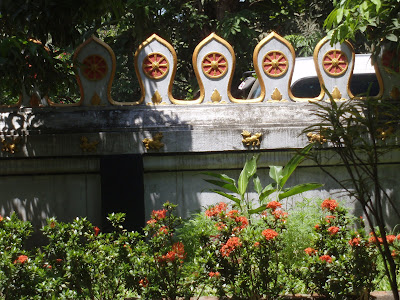
The day starts early. Long before sunrise, throughout the country of Laos, households rise early to make sticky rice (well, our household rose early, failing to finish the task the day before). Sticky rice – khao neow – is possibly the single most ubiquitous item throughout Lao. No household is complete without the tools for making sticky rice. No meal is satisfactory, without at least a few of the sticky little balls. Even in a linguistic sense, the mere name of the holiday Boun Hor Khao Salak includes a reference to khao; rice. However, in this linguistic sense, I believe it refers to ‘harvest’ in general, rather than rice specifically. In the end, for this event, sticky rice and a cane of sugar seem to have an important priority in the list of items we are bringing.

A meal or two worth of sticky rice in the basket, we collect everything we need and head off to the Wat (temple). Offerings vary, depending on one’s financial ability. The very poor may only be able to spare a modest basket of rice, some water and a small taper. For Boun Hor Khao Salak, a piece of vegetation also seems to be something everyone has brought. We stop on the way to the Wat and buy some lotus buds. Something to do with harvest, I guess, or maybe flowers for the deceased.

Those who do not live in abject poverty – a noticeable amount do – will include 1000kip (10¢) notes folded lengthwise as part of their alms. Progressing up the income scale, offerings extend to individually wrapped cookies and cakes. Those who are exceptionally devoted, wanting to contribute to everyone’s greater good, or perhaps have lost an important relative and want to make a more substantial offering, may bring a pre-made care package: a basket of essentials such as coffee, sweetened condensed milk, toilet tissue, soap, incense, candles and other items of use to a novice or monk. Often, the monks will re-gift these to families in need in the village.

Most families have a shiny metal offering bowl which looks like a cross between an American punch bowl and a Russian samovar. The offerings are doled out from this bucket when it is available, otherwise a simple basket will do.

Arriving at Ban Sindha on the outskirts of Vientiane, I am quite nervous. I have never given alms before. I don’t know the process. Adding to my insecurity, I was convinced to wear a formal dress shirt tucked into slacks with a belt and proper shoes on my feet. This type of attire is extremely rare for me and only makes my foreigner-ness stand out more. Much to my relief, a quick glance around the grounds of the Wat assures me I am not overdressed.

The men wear proper long pants, clean, and buttoned shirts. Over their left shoulder, they wear a sash and tie the ends just above the right hip. The women, are even more elegant in thick silk blouses or vests, similar sashes but tied differently and long, calf-length sinhs (traditional skirts) – despite the ultra conservative design, sinhs are surprisingly flattering. Around the grounds of the Wat, mats are laid out for people to sit for the ceremony. We take off our shoes and sit just outside the main building – a dismal view of concrete nothing and a 4000 watt loudspeaker.

There is some confusion. We’ve brought a care package but are unsure how to deliver it. My companion knows to write something on a piece of paper, but is not sure what something to write. She calls her sister – her husband tells us she has already left. She is supposed to join us with brother, she should be here soon. A woman next to us tells us to write the family name on the paper and bring it to the stage where the venerable monks sit.

The ceremonies begin with a prayer broadcasted in dull tones through the PA system. I don’t understand a single word of these prayers, but I have come to enjoy them all the same. The first time I heard this type of prayer it was at a Baci ceremony where I was the guest of honor. There seems to be a certain magic in the chanting. At that Baci ceremony, I felt a distinct lightness, a euphoria, washing through, over, around and beneath me. Since then, I always try to allow the power of the chant envelop me instead of frustrating myself with my lack of vocabulary. People have a full conversation during these prayers – it seems perfectly ok.

After the chanting, alms are delivered. There is a long table with 10 baskets. Each basket has a bowl for sticky rice and a bag for candy and cash. First, the elders give alms. These men appear to be like deacons in a Christian church, assisting with the other logistics of the ceremony. After the male elders give alms, the rest of the men in procession pass each of the baskets lined up on a table. I take my place as the last male. I mimic the men in front of me. First, a ball of sticky rice is placed in the basket. Then, a 1000 kip note and a cake or candy is raised to the forehead and then placed into the bag. I get confused. I forget to put rice in one of the baskets. A deacon sets me straight. There is no possibility I will go unnoticed.

The women proceed to give alms in the same way. Then children give alms. There are three of us, myself, a woman and a teenage boy; we share our offering bowl in turns. After everyone has finished with this, we return to our mats for another prayer – another moment of touching the occult dimensions of our existence whether we comprehend or not. After the second prayer – or maybe during – the elders collect the alms given and bring them to the main building.

Next, an offering to deceased relatives is made. Smaller balls of sticky rice are offered. The woman next to us is poor; she makes four small balls of sticky rice and places them on a leaf in front of her. We have a little bit more money, so instead of a leaf, we used our shiny offering bowl. It’s silver colored tin. Others have gold colored bowls, also made of tin. I see a woman with a beautiful hardwood carved offering bowl.

We make three small balls of sticky rice and place them on the edge of the bowl. Then, in unison with the other practitioners, we pour water into the bowl. The less advantaged woman to our left had a small 7oz bottle of water to offer into the leaf she had placed on the ground; we had a 750ml bottle. She has a taper; we forgot to bring one. We drain the entire bottle of water into the bowl. (I’m later told this was also an preparation oversight on our part and a small bottle would have sufficed.) After this, the group-led part of the ceremony concludes with very little fanfare – a couple of bows.

People stand up from the mats and with their offerings in hand approach one of the many stupas (ornate gravestones) on the perimeter of the grounds of the Wat. Another silent prayer is made and the water and rice are poured onto the ground or placed on the stupa. Some people have left small tapers burning there.

Then everyone leaves. They leave nonchalant, with barely any expression of relief or fortitude or any other apparent show of emotion. The whole affair seemed to be as mundane to them as washing one’s face in the morning – maybe even less exhilarating. However, wrapped inside of this seeming indifference, there is a casual solemnity, a Sunday morning feeling. Quiet. Placid.

Pulling out of the grounds of the Wat on the motorbike, I ask my companion, “So, today is a worker’s holiday?”

“Yes.”

I check my watch; it’s just before 9 a.m., “So that means all of Laos will be drunk by 11?”

“Mmmmmm,” Mmmmm means ‘yes’ in Lao. To the westerner, it is a non-committal response, but to the Laos, it is as sure as saying yes.

I am under the weather; a nagging chest cold set on by that dastardly air conditioner. Unfortunately, I will have to skip the rest of the celebration and observations of the holiday. During the daytime, I understand, there is some Lao dancing, which no doubt goes well with Beer Lao and whiskey. At night, there is a candle ceremony, which I also regret planning to miss.

In the afternoon, as I convalesce in bed, the phone rings. Bad news. Uncle Won has passed away. I had just met him the day before. He had pneumonia – advanced stages of it. He was a man of medium build, but the months of illness had deteriorated his body to a mere 30 some-odd kilo. His bones poked through his skin like a tortured, starved prisoner. He sat away from the group, knowing his contagion. I watched his eyes, dark and glassy – watching us childlike in his not knowing yet mannish in his recognition that his time on earth is coming to an end. He smoked a cigarette and went back to bed.

When the news comes, there is a sputter of panic on cell phones. Each brother and sister and aunt and cousin and uncle and brother in law is calling the other with news of his passing. I am home alone. I am useless on the phone. Baw khow jai. I don’t understand. Oddly, I know the word die, but I don’t recognize it out of context.

To die on Boun Khao Salak is a very inauspicious event – the body will have to be brought to the crematorium on the same day. Some more sputters of cell phone calls and the matter is settled; it was a misunderstanding. Uncle Won passed away the night before. Presumably the news was delayed to avoid upsetting the alms giving of the morning. Or more likely, someone just didn’t get around to it. One cousin did not find out until a full day later.

Still under the weather, I ask if it would be a great insult to skip the funeral. As much as I would like to have gone to pay respect and to learn a bit more, it would be unwise for a sick man to attend. They will understand, but there will be plenty of questions about my absence. Even though they know I don’t talk, they seem to like having me around. I think again about Uncle Won’s eyes. It will be a full year before a ball of sticky rice is offered to his spirit – to make him feel warm in the meantime, I leave a small portion of sticky rice on my plate at dinner.

Sunday, September 23, 2007

Blog Action Day

I just heard about something which has caught my attention. Sorry if this is old news, I’m a little sheltered, here in Southeast Asia. It is called Blog Action Day. On October 15th, over 5,000 bloggers will post something regarding the environment. I think this is a very interesting experiment/demonstration/field test.
Blog Action Day poses the question: “What would happen if every blog published posts discussing the same issue, on the same day? One issue. One day. Thousands of voices.”
Have you ever had the experience of learning a new word and then it seems like everyone around you is using it? I’m wondering if Blog Action Day will generate a similar result. Will dinner tables, news agencies, coffee clutches around the world all, through six degrees of separation, turn their attention to the environment as a result of Blog Action Day?
As for me, I think it’s time well spent to create an entry on that day to talk about something to do with the environment – probably something relating to my observations in Laos, an emerging country with some very serious environmental risks looming in the near future.
Take a look at the Blog Action Day website, you may find it interesting. http://blogactionday.org/

Saturday, September 22, 2007

Guava Mouth

Seven score and one week ago, Abraham Lincoln, issued the Emancipation Proclamation. Tomorrow will mark the fifty year anniversary of 9 black students entering the doors of the exclusively white Central High School in Little Rock Arkansas. Over the years, things have become much better in the USA, not only for blacks, but also Asians, Latino and all other ethnic groups. Many people will say racism is a big problem in the US. While I don’t disagree that racism is an issue in American culture, I have to say that it is not nearly as bad as other places.

As a white man living in Vientiane, Laos, I face a daily barrage of racism. Most of it is petty remarks or assumptions (I’m white hence I filthy rich). While most Laotian people are friendly and welcoming, racism is an inescapable fact of life for whites in Asia. I spend an inordinate amount of time and energy thinking about, dealing with, and deflecting racism.

Last weekend I went to the supermarket to restock my cupboard. This particular supermarket is located at ITECC (Lao International Trade Exhibition and Convention Center) and has a good selection of western and eastern food. I like shopping at ITECC because not only does it have some hard to find items (kidney beans in a can, for example), but there is something about supermarkets that I find very comforting. Even in my own country, I will often spend a couple hours wandering the aisles of a supermarket during off hours. However, the experience I had last weekend was not as comforting as I had hoped.

About midway through my shopping, two small Laos children unaccompanied by an adult, noticed me. “Falang! Falang!” they yelled. Falang is what they call foreigners in Laos. They made a big production out of my being in the supermarket. Hanging on to my cart, touching everything I had placed there, they continued to shout, ‘Falang’ and other observations their language such as bald, big, big nose and so forth. Everything I touched, they had to touch. And they said things like “Falang likes this” or Falang likes that. The other shoppers chuckled at this – some ignored it. I tolerated their behavior since I can understand that I may be quite different than what they are used to. After about 15 minutes of these two kids pestering me, I finally said, in English, “Ok, enough, time for you to hit the highway.” They disappeared.

Later, I thought about this experience. I thought about how that would go over in my own country. What would happen in an average American supermarket if two white kids followed an Asian around yelling “Asian!, Asian!”. Would the other shoppers chuckle? Would the store manager walk by, blandly amused. Ah, just kids!. I don’t think so. I think if a kid did that in a Southern California supermarket, at best they would be dispatched from the store. If I were there to witness it, they would have the pleasure of hearing a very long and sharp-tongued lecture on the shame of broadcasting ones ignorance and hate filled mind.

This type experience is not an unusual occurrence, it’s just one example. I try to explain to my Laos friends how, in my culture, if a shop keeper tried to charge varying prices based on the color of someone’s skin, they would very quickly be in serious legal trouble. If a group of customers all stood around joking about how an Asian immigrant could not pronounce words as well as they should, I would think there is a good chance someone would speak up and say “Hey, that’s not right”. I know this type of thing does happen in the USA, but not anywhere near as frequently as it does in Asia.

I wonder about the source of racism in America, specifically, anti-Asian sentiment. I don’t think I’m going to win any friends with this next remark, but I have to say it. Is it possible that some of the racism Asian-Americans feel comes from their own deeply ingrained racist behaviour?

It’s a slow day for beggars today – five in one hour, 3 repeat visitors. The rich Lao people sitting at the next table are not approached. The beggars only beg from white people.

For a little more understanding of the word Falang, this person’s blog sheds a little light on the etymology and blithe attitude of racism in Southeast Asia: Real Life Thailand - Farang kii nok

Wednesday, September 19, 2007

Free Market Mirage

A colleague of mine and I have lost touch for the past year an a half while I have been in Southeast Asia. The other day, I noticed him on Facebook and added him as a friend. My reasoning for wanting to stay in touch with him is twofold. First, I consider him a friend; a person who I respect immensely for both his professional acumen as well as being a man of impeccably good character. Second, I want to stay in touch with him because, professionally, we share the same ideology of enthusiasm, integrity and an inquisitive nature – hence, there is potential for us to enter into mutually beneficial business relationships. (As an additional note, Naisan’s capacity for light-speed synapse inspired many advanced educational techniques I developed between 2003 and 2006)

Looking into his current endeavors, I noticed he has a blog at www.naisan.net\blog. His latest entry dealt with the death of capitalism. I found it very interesting to read his short post and move my mind back to the conditions of the USA while I have been immersed in a very different situation here in Laos.

As capitalism dies from the insidious workings of the omniscient “them” back in the USA (and in most of the globe), I am watching Laos go through the painful birthing of it’s own form of one-party capitalism. Laos, in an attempt to sustain itself as a sovereign nation and free itself from least developed nation status by 2020, has entered into a free market economy. It’s not like there is much choice for Laos. After decades of solidarity with the Soviet Union, once big brother conceded that great philosophical mind-plays are not always sustainable socio-economic methods, Laos had to enter into the global market.

How will that work? I wonder. How will a country who has sustained itself in a vacuum outside the free market since 1975, transfer it’s ideology to a free market mindset while at the same time the world free market seems to be collapsing under the weight of the likes of Cheney, Bush, GE, Haliburton and the rest of the behemoths? Will this birth into free market become a stillborn lark – too little, too late – or will Laos’ expertise learned from decades of corruption, lobbying and special interests be boon to its role in the soon coming free market mirage?

DISCLAIMER: Of course, what I write here is merely off-the-cuff, personal pontifications. I certainly do not claim to be an expert on capitalism, communism, socialism or the current state of affairs on the global economy – or even the Peoples Democratic Republic of Lao, for that matter. I shudder at the thought that any harm would come to the nation of Laos – a country I love immensely and for which I have great respect for the perseverance of it’s people and leaders.

By the way… beggar count today: 22 individuals in 90 minutes. Four adults, 18 children. Akiki is taking the day off, I guess.

Monday, September 17, 2007

Begging Monopoly

Begging. I don’t like begging. I used to give money to beggars. Now, only under a very extreme circumstance will I give a beggar anything at all and in those cases, only food. It’s not that I am unsympathetic, it’s just that I can not tolerate the idea that a stranger who is completely uninterested and unwilling to do anything for me expects me – often demands of me – to fork over my own cash. I just don’t work that way.

Back in the 1980’s when I was living in Brooklyn, there was a beggar at one of the subway stations in my neighborhood. Each day I would see him sitting in the passageway mumbling to himself with his hands outstretched. On occasion, early on, I would drop a few coins in his hands. Then, one day, I realized that I had been passing this same person in the same place wanting the same thing for a very long time. I thought about it. I had had over a dozen jobs over 8 years, moved house five times, put myself through school, bought a car, wrecked the car, sold the wreckage, got married, went from wearing $80 suits to wearing $800 suits… why on earth did I give this man money? His “job” was to profile those people who have money and expect them to hand over their cash, assuring them he had no intention of doing anything other than living off their wages.

Now, granted, this is not a simple subject. The man clearly had some mental problems and Mayor Koch had flushed New York City’s mental hospital funding so the man was at a huge disadvantage (Koch later funded an effort to involuntarily remove the mentally ill from NYC streets). Once the markings of disenfranchisement manifested; soiled clothes, unbathed body, tangled hair, unwashed teeth, deprivation of medication, getting any form of employment was much more difficult. The momentum grew in his terrible plight. However, I firmly believe the number one reason why this man was (and still is as of 2005) begging, is because he makes money doing it. Lots of money.

I know another man in Vancouver, Canada. He is a crack addict. He gets funding from the British Columbia government to pay for housing and food. He uses 100% of his begging income for drugs and alcohol. I’m not making this up – I’ve had plenty of conversations with him. Each night you can find him outside the 7-Eleven on 10th and Alma asking people for money and cigarettes (retail value of one cigarette in BC is about $0.50CDN). Does he have any intention of stopping drugs or stopping begging? Absolutely not. He likes crack. And the 7-Eleven customers have no problem paying for it.

Why am I talking about this today? It is something that I have been paying attention to here in Laos for over a year. A year ago I noticed only a few beggars on the streets of the central tourism area of Vientiane. Today, I see a dramatic growth. A more official counting by Peuan Mit/Friends-International in October 2004 counted 209 street children in one day. Whatever the actual numbers may be, I am confident in my observation that there is a very real growth surge in the begging industry in Laos.

One of the most notable and prominent beggars in Vientiane, Akiki, sits outside Joma Bakery (the most expensive coffee shop in the city) or next door at the Phimphone Market (one of the most successful retail businesses in the city). He’s a nice enough guy and is respectful to his “customers”. To be fair, I should mention that Akiki has Downs Syndrome. And, granted, it is hard enough for a skilled, healthy, young man to find work in Laos, let alone a person who is mentally or physically challenged. However, there is no way Akiki is going to change his profession. Why? Money. Lot’s of it.

Consider the average monthly wage for a government worker in Laos is 350,000kip/month (about $35USD). One afternoon, I watched how much Akiki earned in 3 hours: 150,000kip. I’ve seen him make less, but certainly those numbers are not unusual. I have even had discussions with others who, like me, have seen him using his ATM card. An ATM card!!!

The other day, right after I posted my last entry, “Coopetition”, I saw Akiki do something which inspired me to write this entry. It was a thought of competition. I was sitting outside the Joma Café when three other street children had approached me for money. I told them no. They were about to approach the other table sitting outside when Akiki jumped up from his spot next door, blew his police whistle, and chased the 3 others away. It seems that not only does Akiki make a Laos fortune at his job, but he maintains a monopoly on his place of business (he does share it with one physically handicapped boy, on occasion).

Is Akiki, or the other alleged 208 beggars in Vientiane to blame for this? No, not really. He may have a monopoly on those two storefronts, but there are plenty of other places to beg. It’s not really the location, it’s those people who fund the industry who are most at fault. And the people who are funding this operation are the tourists – tourists with wonderfully benevolent intentions.

Some people give money to ease their conscience. Others, out of pity. Still, others, really believe they are helping someone. Whatever the reason, at the core of the issue, it is ignorance the fuels the begging industry. People who give money to beggars are ignorant of the problems they are causing – giving money to beggars causes much more damage than relief. Do people really think that beggars don’t talk to each other? Of course they do. And they know exactly how much they can earn and from who they can earn it (maybe, tomorrow, I will elaborate on that one).

Furthermore, behind the scenes of this industry is a much more insidious menace at work. It is often organized crime, the mafia or a mafia, orchestrating the begging circuit. If the cartel came to you safe suburban door and asked for money, exactly how much would you give… to ease your conscience?

Maybe I am opening myself up to a lot of criticism, but it is important to spread the word. Under no circumstances should anyone respond to begging with anything other than a polite ‘NO’. If you feel you must give a portion of your income to the needy, do so in a proper way. Here’s one example: $50 = One below the knee prosthesis - COPE Laos. Using PayPal, about 7% of your $50 donation is NOT used towards helping someone in need; the rest goes directly towards the recipient’s care.

In the time it took me to write this (which included a number of delays and stopping for lunch), I was approached seven times by different beggars. In the same time, I did not see one single Laos national approached for money. It is clear that tourists are targets but it is not only because of the apparently enormous cash roll they are carrying, but also because they do not understand what they are financing: a highly competitive, dangerous, and self-esteem destroying, unnecessary way of life.

Never stand begging for that which you have the power to earn
– Cervantes

Saturday, September 15, 2007

Coopetition

Too often people think that one person’s success precludes another’s. This simply is not true. “Miss Hoyle” on MySpace published a list of 33 writer’s contests on her blog the other day. In her introduction she says, “Okay, I might be shooting myself in the kneecap here by sending "my competitors" all this information; but in truth, I think we writers need to work together.”. I could not agree with her second thought more.

One of the projects I intended to complete in Laos was a series of podcasts providing information about major tourist attractions in Laos. Just the other day, an acquaintance asked me how the project was going. I winced. The podcasting project I intended to do was shelved for one major reason: I could not find a Lao national who was willing to put forth the effort to learn about these things and visit the attraction. Despite not finding a co-narrator, I continued for a couple months writing draft scripts for the project, but eventually saw the writing on the wall and abandoned the project.

Today, on Craigslist, I found a site who is looking for exactly this type of thing. Authors/narrators are free to set their own prices (if any) and can publish at their own pace. The site is called Audio Snacks and they want people to submit recordings of guided tours of any place where they have “inside knowledge”. As a result, I am thinking about reviving my own project of podcasting in Laos.

Have you ever seen someone get bent out of shape because someone else got a job, materialized an idea they had or achieved some other form of success? Have you ever felt this yourself? It’s an outrageous reaction to someone else’s success and it is completely in the wrong direction. Success is like love – there is an infinite supply of it. All you have to do is chip in, share, and keep an open mind. There is plenty for all of us and it has a compounding effect on the world.