Boun Hor Khao Salak. What is it? Ask an average, young Laos person and unless they have spent time as a monk, there is a small chance they can give much of an explanation. For most, the explanation is simply ‘day we give alms’. This religious holiday, also a worker holiday, comes at the last full moon during Boun Khaophansa, Buddhist Lent. It seems each full moon has a specific importance; last month’s full moon was the day to honor the spirits of the dead; this month, it is to give alms and to make offerings to deceased relatives.
 The day starts early. Long before sunrise, throughout the country of Laos, households rise early to make sticky rice (well, our household rose early, failing to finish the task the day before). Sticky rice – khao neow – is possibly the single most ubiquitous item throughout Lao. No household is complete without the tools for making sticky rice. No meal is satisfactory, without at least a few of the sticky little balls. Even in a linguistic sense, the mere name of the holiday Boun Hor Khao Salak includes a reference to khao; rice. However, in this linguistic sense, I believe it refers to ‘harvest’ in general, rather than rice specifically. In the end, for this event, sticky rice and a cane of sugar seem to have an important priority in the list of items we are bringing.
A meal or two worth of sticky rice in the basket, we collect everything we need and head off to the Wat (temple). Offerings vary, depending on one’s financial ability. The very poor may only be able to spare a modest basket of rice, some water and a small taper. For Boun Hor Khao Salak, a piece of vegetation also seems to be something everyone has brought. We stop on the way to the Wat and buy some lotus buds. Something to do with harvest, I guess, or maybe flowers for the deceased.
Those who do not live in abject poverty – a noticeable amount do – will include 1000kip (10¢) notes folded lengthwise as part of their alms. Progressing up the income scale, offerings extend to individually wrapped cookies and cakes. Those who are exceptionally devoted, wanting to contribute to everyone’s greater good, or perhaps have lost an important relative and want to make a more substantial offering, may bring a pre-made care package: a basket of essentials such as coffee, sweetened condensed milk, toilet tissue, soap, incense, candles and other items of use to a novice or monk. Often, the monks will re-gift these to families in need in the village.
Most families have a shiny metal offering bowl which looks like a cross between an American punch bowl and a Russian samovar. The offerings are doled out from this bucket when it is available, otherwise a simple basket will do.
Arriving at Ban Sindha on the outskirts of Vientiane, I am quite nervous. I have never given alms before. I don’t know the process. Adding to my insecurity, I was convinced to wear a formal dress shirt tucked into slacks with a belt and proper shoes on my feet. This type of attire is extremely rare for me and only makes my foreigner-ness stand out more. Much to my relief, a quick glance around the grounds of the Wat assures me I am not overdressed.
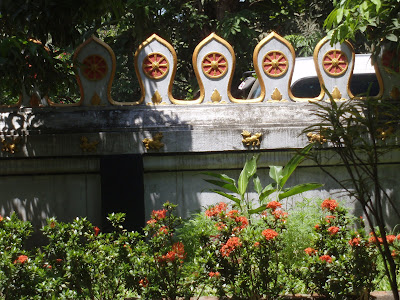
The men wear proper long pants, clean, and buttoned shirts. Over their left shoulder, they wear a sash and tie the ends just above the right hip. The women, are even more elegant in thick silk blouses or vests, similar sashes but tied differently and long, calf-length sinhs (traditional skirts) – despite the ultra conservative design, sinhs are surprisingly flattering. Around the grounds of the Wat, mats are laid out for people to sit for the ceremony. We take off our shoes and sit just outside the main building – a dismal view of concrete nothing and a 4000 watt loudspeaker.
There is some confusion. We’ve brought a care package but are unsure how to deliver it. My companion knows to write something on a piece of paper, but is not sure what something to write. She calls her sister – her husband tells us she has already left. She is supposed to join us with brother, she should be here soon. A woman next to us tells us to write the family name on the paper and bring it to the stage where the venerable monks sit.
The ceremonies begin with a prayer broadcasted in dull tones through the PA system. I don’t understand a single word of these prayers, but I have come to enjoy them all the same. The first time I heard this type of prayer it was at a Baci ceremony where I was the guest of honor. There seems to be a certain magic in the chanting. At that Baci ceremony, I felt a distinct lightness, a euphoria, washing through, over, around and beneath me. Since then, I always try to allow the power of the chant envelop me instead of frustrating myself with my lack of vocabulary. People have a full conversation during these prayers – it seems perfectly ok.
After the chanting, alms are delivered. There is a long table with 10 baskets. Each basket has a bowl for sticky rice and a bag for candy and cash. First, the elders give alms. These men appear to be like deacons in a Christian church, assisting with the other logistics of the ceremony. After the male elders give alms, the rest of the men in procession pass each of the baskets lined up on a table. I take my place as the last male. I mimic the men in front of me. First, a ball of sticky rice is placed in the basket. Then, a 1000 kip note and a cake or candy is raised to the forehead and then placed into the bag. I get confused. I forget to put rice in one of the baskets. A deacon sets me straight. There is no possibility I will go unnoticed.
The women proceed to give alms in the same way. Then children give alms. There are three of us, myself, a woman and a teenage boy; we share our offering bowl in turns. After everyone has finished with this, we return to our mats for another prayer – another moment of touching the occult dimensions of our existence whether we comprehend or not. After the second prayer – or maybe during – the elders collect the alms given and bring them to the main building.
Next, an offering to deceased relatives is made. Smaller balls of sticky rice are offered. The woman next to us is poor; she makes four small balls of sticky rice and places them on a leaf in front of her. We have a little bit more money, so instead of a leaf, we used our shiny offering bowl. It’s silver colored tin. Others have gold colored bowls, also made of tin. I see a woman with a beautiful hardwood carved offering bowl.
We make three small balls of sticky rice and place them on the edge of the bowl. Then, in unison with the other practitioners, we pour water into the bowl. The less advantaged woman to our left had a small 7oz bottle of water to offer into the leaf she had placed on the ground; we had a 750ml bottle. She has a taper; we forgot to bring one. We drain the entire bottle of water into the bowl. (I’m later told this was also an preparation oversight on our part and a small bottle would have sufficed.) After this, the group-led part of the ceremony concludes with very little fanfare – a couple of bows.
People stand up from the mats and with their offerings in hand approach one of the many stupas (ornate gravestones) on the perimeter of the grounds of the Wat. Another silent prayer is made and the water and rice are poured onto the ground or placed on the stupa. Some people have left small tapers burning there.
Then everyone leaves. They leave nonchalant, with barely any expression of relief or fortitude or any other apparent show of emotion. The whole affair seemed to be as mundane to them as washing one’s face in the morning – maybe even less exhilarating. However, wrapped inside of this seeming indifference, there is a casual solemnity, a Sunday morning feeling. Quiet. Placid.
Pulling out of the grounds of the Wat on the motorbike, I ask my companion, “So, today is a worker’s holiday?”
“Yes.”
I check my watch; it’s just before 9 a.m., “So that means all of Laos will be drunk by 11?”
“Mmmmmm,” Mmmmm means ‘yes’ in Lao. To the westerner, it is a non-committal response, but to the Laos, it is as sure as saying yes.
I am under the weather; a nagging chest cold set on by that dastardly air conditioner. Unfortunately, I will have to skip the rest of the celebration and observations of the holiday. During the daytime, I understand, there is some Lao dancing, which no doubt goes well with Beer Lao and whiskey. At night, there is a candle ceremony, which I also regret planning to miss.
In the afternoon, as I convalesce in bed, the phone rings. Bad news. Uncle Won has passed away. I had just met him the day before. He had pneumonia – advanced stages of it. He was a man of medium build, but the months of illness had deteriorated his body to a mere 30 some-odd kilo. His bones poked through his skin like a tortured, starved prisoner. He sat away from the group, knowing his contagion. I watched his eyes, dark and glassy – watching us childlike in his not knowing yet mannish in his recognition that his time on earth is coming to an end. He smoked a cigarette and went back to bed.
When the news comes, there is a sputter of panic on cell phones. Each brother and sister and aunt and cousin and uncle and brother in law is calling the other with news of his passing. I am home alone. I am useless on the phone. Baw khow jai. I don’t understand. Oddly, I know the word die, but I don’t recognize it out of context.
To die on Boun Khao Salak is a very inauspicious event – the body will have to be brought to the crematorium on the same day. Some more sputters of cell phone calls and the matter is settled; it was a misunderstanding. Uncle Won passed away the night before. Presumably the news was delayed to avoid upsetting the alms giving of the morning. Or more likely, someone just didn’t get around to it. One cousin did not find out until a full day later.
Still under the weather, I ask if it would be a great insult to skip the funeral. As much as I would like to have gone to pay respect and to learn a bit more, it would be unwise for a sick man to attend. They will understand, but there will be plenty of questions about my absence. Even though they know I don’t talk, they seem to like having me around. I think again about Uncle Won’s eyes. It will be a full year before a ball of sticky rice is offered to his spirit – to make him feel warm in the meantime, I leave a small portion of sticky rice on my plate at dinner.
 Let’s get back to Buddhism for a while. I really don’t think it’s necessary to categorize something as Buddhism or not-Buddhism; after all, there is really not much difference between the two. When I write about racism, I am writing about right mind. When I write about teaching, I am writing about right action. I don’t come right out and say it, but the truth is, I’m always writing about the dharma. The benefit, the practice, the use and abuse of the dharma. I have to write about it, not because of my vows, but because of something which has been cultivated in me over thousands of lifetimes.


