Monday, August 13, 2007

Don't Wait

I had a conversation with someone the other day. She was depressed. She wondered, What will do? How will I do it? How can I do anything? I can not do anything. She’s twenty-one years old and doesn’t know which direction her life is going.

Listening to her grief, I thought of my self when I was that age – actually, for most of my early twenties I worried about such things, sometimes sinking into a deep fatalistic depression. I let her vent her fears and concerns for a while and tried to turn her in the direction of a little less self-pity and a little more action.

“You’re still young,” I told her, “you don’t have to know what you’re going to be when you grow up. Don’t worry, it will come to you.”

It’s not very easy to accept such advice. It puts a lot of faith on something that no one can back up without the passage of time. I tried a different, more tangible tactic to help my friend pull herself out of her self-inflicted malaise.

She doesn’t know what she wants to do. That’s ok. There are plenty of times in life when we don’t know what we are going to do next. Eventually, the idea will come and it is at that time we must act. Which brings me to the title of today’s entry, DON’T WAIT.

When we are not sure of what we will do next, that is not the time to sit and wonder what we will do next. Obsessing on our own confusion gets us no where other than more deeply entrenched in our own confusion. It serves only to make us feel worse and make arriving at a decision a painful waiting experience.

Of course, if you don’t confront your problems, they will never be resolved. However, once confronting our problems becomes the problem itself, then it is time to focus our attention elsewhere and allow time – and our subconscious genius – to work out a suitable solution.

I told my friend to table her worries of what will she do and focus instead on how she will do. Worrying about what you will be when you grow up is not helping.

I suggested to her, “Instead of worrying, why don’t you learn how to succeed first.”

The expected blank look came to her face. People all around the world do not know of this method, however, it is viable and very effective. Learn how to succeed and you will succeed at whatever you choose. The secret of succeeding is not a matter of getting lucky or having the right contacts. The secret is to teach oneself how to set goals and achieve them. Be warned, though, learning how to succeed starts small and is greatly reliant on setting realistic goals.

Twenty-one years old. Don’t know what to do. Don’t know how to do it. Can’t do anything. It seems like a very short dead end street to me. But look over there, not too far off this path is another path. A path begging to be explored. It’s a path where specific, measurable, achievable, realistic, time-based (SMART) goals can be set and reached Set your sights low at first. I will make sure all my bills are paid and all my accounts are up to date each Friday for the next two months. Maybe that’s too aggressive. For five consecutive days, I will wake up each morning before 9:00 am and make at least one phone call to a prospective employer. Eventually, your goals will become more complex as you master setting and achieving goals. Then you will be prepared to do what you want to do when you grow up.

It’s not so much a matter of what your goals are. It’s more a matter that you train yourself to set smart goals, approach them with clarity and determination and recognize the rewarding feeling of accomplishing what you said you would do. It’s a very useful technique for strengthening the success muscles. Something I wish I had learned twenty years earlier. Something I wished I knew about when I was sitting around, feeling sorry for myself, wondering what I would be when I grow up. I could have been spending that time teaching myself how to succeed so that once I figured out what I would do, I would have some experience in achieving my goals.

Friday, August 10, 2007

Amateurs

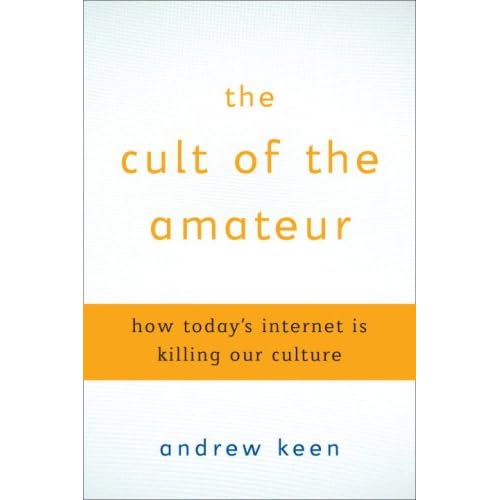
There’s a reason to my lack of posting lately. It has to do with a newspaper article I read poolside at the Nana Hotel in Bangkok (fifteen stories of perversion in Sukhumvit). The article was a review of a book called “The Cult of Amateur: How today’s Internet is killing our culture” by Andrew Keen. I can’t find a copy of the book here, but I’ve read a number of reviews and reader-reviews. Most people say the same thing: it gives provocative insight, but goes off the rails in some areas. Regardless if the book is good or bad, it’s existence and general sentiment has made me think a little bit more about what I’m putting out in blog form.

There is a compounding element that has added to my paralyzed efforts. Much of the content I produce is based on Buddhist philosophy. One of the Buddhist principles is to not disseminate false information (ubiquitous in all faiths... I think). Ethically I do have some responsibility to be accurate when presenting any material; personally, I feel this even stronger in the context of religion or spirituality. While never presenting myself as an expert on the subject and using some good-ol’ fashioned doing the best I can, I hope to maintain some form of immunity.

I read those words and can not help but wonder: Immunity from what???

Do we need immunity in order to speak or act or write? Do we need licenses – certifications of authenticity – to empower us to share an idea, opinion or belief? Is the onus on the speaker, and not the listener, to define what is fact and what is conjecture? If so, I need to shut up a long time ago.

Similar to the padded playground where no one learns to be careful because they don’t understand how much broken bones hurt, people are trying to muzzle free, misinformed, communication. Long before the world became literate (or started down that path), Og was free to go up to Toh and grunt for as long as Toh would entertain him. Toh never believed Og’s grunting, but he would listen to it from time to time, just to get another perspective. Toh is a brave man for taking his chances with the myriad misinformation outside the padded playground.

The cult of amateur goes back much further than the internet, so does the killing of culture. Amateurs have been badly fixing their own tools, poorly advising their children, inappropriately consoling their heartbroken friends and a doing a bad job with a whole plethora of other things for centuries. They’ve had no formal training, often gave lousy advise and disastrous results have followed. Other times, a laymen has provided good advice leading to healthy marriages, community progress, even scientific or artistic breakthroughs. Sometimes, it’s not even the quality of the advice but the cathartic nature of communication itself which spawns a bright ending.

So, if communication – and I stress, communication of unwittingly false information – is the death of our culture, how long ago did our culture begin to die? Certainly no one ever thought that cats would steal the souls from sleeping infants and no one ever told another person that bathing was a deadly act. No chef ever told another that tomatoes were poisonous and there was never an educated person who believed the world was flat.

My opinion, which is always to be regarded with great skepticism, is that the cult of amateur is exactly what defines culture. It is the expert who categorizes culture, yet it is the amateur who constitutes it. Nothing new is happening here. Og and Toh grunted. Horace Greeley duked it out with the penny press. Oprah hosted the highest rated talk show in television history. Og, Toh, Horace and, I believe, Oprah, had no college education, no doctorate in anything and certainly no credentials other than they experienced, they listened, they decided what they believed and then they spoke up – sometimes inaccurately with disastrous results. Calling Horace and Oprah amateurs isn’t really fair since they are experts in spinning information. However with the clarity of retrospect, ask a General and not a newspaper editor where to send troops; ask a therapist and not a talk show host how to save your marriage.

Are we a culture who buys into bogus beliefs? Certainly. Yet, it isn’t the people spewing those beliefs who need corrective action. It is the audience who must question the source and the validity of anything they hear or read. It’s a scary world out there. You will be on your own deciding what to believe and what to dismiss. Have faith that you, too, will make a bad decision from time to time. You will probably also say something that isn’t exactly true. But don’t worry about killing your own culture, it’s been dying for a lot longer than you think.

[By the way, some things in this entry I looked up on the internet. It’s definitely all true, because someone put it on a website.]

Thursday, August 02, 2007

Answers?

Do you have the answers? Are you sure? It may come as a shocking surprise but not all that we think is true. It may be true for a while, but all things must come to an end. Perhaps information is not excluded from this.

An expert on smell and scent claims that not all things have a smell. He explains that for something to have a smell it must emit molecules the size of 16 carbon atoms or less in order for it to have smell. He sounds quite certain of this. However, I can not help but think of the koanif a tree falls in the forest and no one is there to hear it, does it make a sound?’. If something emits a scent larger than 16 carbon atoms, a size too big for our olfactory system, is it void of scent or is it us that is void of perception? Here is where I, the layman with no scientific training, and the expert, with a vast repertoire of research, must part ways.

We are an audacious species. We know only what we can think. And we refute that which is incomprehensible or indiscernible. Yet that does not prove it does not exist. We have ghosts and spirits and psychic activity on the fringe of our accepted common knowledge to occupy the time of rebellious thought pioneers. But what lies beyond this fringe area? How vast is the space which exists beyond the universes? How vast is the space which exists beyond our thoughts?

As a child, we believe that mom and dad are gods. Later, our teachers become emperors and empresses. Hormones kick in, teenage rebellion overtakes our previous knowledge and mom, dad and teachers take an icarian dive. We grow even older and outrunning the cops changes from exciting to pure stupidity. Time passes and we slip from resenting our seniors to the asking those more experienced for advice. Age seeps in and, eventually, we end up liking elastic waistbands because they are more comfortable, more practical, like cataract sunglasses.

Answers change and we need to accept this. We need to acknowledge that what might have been perfect yesterday is only tolerable today and tomorrow we have no taste for it. That is only the tip of the iceberg. How much of what we know is absolutely wrong, and yet we all buy into this mass hypnosis from lack of energy or fear of going against the grain?

This could go on forever. But I know I have vinegar to buy and a lamp to fix and a few other errands to run. Perhaps I will see a ghost at the market. Perhaps I will levitate with my packages over the chaotic traffic. Perhaps I will discover that my reserves of love are three times the size of a molecule I can smell. I don’t have the answers, only observations.

Wednesday, August 01, 2007

Who?

During last night's dinner conversation...

Shakespeare, William Shakespeare, the famous playwright?
hmmmm... I've never heard of Shakespeare. I've heard of Britnay Spears.
No relation.

An explanation of the terms genius and bubble gum followed.

Tuesday, July 24, 2007

Something to Say?

One of the most uncouth things a person can do – and one of the most frequent faux pas of falang in Southeast Asia – is to raise their voice. Raising one’s voice shows a myriad of flaws. It shows loss of self-control. It shows unnecessary disrespect. It shows ignorance to local culture (when in Rome…). Most of all, it shows everyone within earshot the skid marks in your own underwear.

This morning I skipped the 7:30 departure to a particularly good dive location. I wanted to sleep in. I wanted to rest a little extra before heading back to the mainland and my quiet and orderly existence in Laos. By habit, I woke at 7:00 a.m., checked the time and opted for more sleep. At 7:55, I was awakened by voices outside. I could hear the voices, but could not make out the words. I slid back into sleep. The voices continued. By 8:05, I abandoned by grandiose thoughts of sleeping until 9 or maybe even 10; the voices showed no sign of stopping.

I listened more closely. Was someone telling an exciting tale of last night’s adventures? I hoped so. I got up and went to the bathroom. I tried to peek through the ventilation slits of the concrete wall to see what was happening outside – I thought of my nosy ex-wife who always peered through curtains and wanted to know what was going on with other people. I couldn’t see the men. There were two men. I could tell from the voices. One was English. The other I thought to be Thai. The Thai voice was trying to express, to console, to empathize, to find a suitable solution. The English voice spoke over and beat down on the Thai voice – he did not want to hear, he only wanted to have his say, to assert his rightness, to aggress his own absolute perfection. The Thai voice was calm and rather quiet. The English voice was everywhere and demanding. Did he want a refund? I thought of a trip to Jamaica years ago when a honeymooner wanted a refund in early October because the brochure failed to mention the daily rain in the Caribbean in October. I pissed, dressed and walked outside.

Stepping onto the porch, the words were now discernable. Bed bugs… I didn’t put bed bugs in the mattress… It’s your fault… if anyone is responsible for bed bugs it’s you. The Englishman had a long brown shit stain flowing out of his mouth. The Englishman thinks the Thai intentionally wants itchy guests who will tell others about a crappy resort where conditions are substandard. The Thai is patient and as I step out onto the porch, the conversation ends. The shirtless Englishman with an homogenously rebellious tattoo on his lower back walks away with flippant gestures and aural puss seeping into the sand. The Thai is smiling, not because he has won or because he is happy or because he enjoyed an 8:00 am pissing contest or because his other guests had to listen to this nonsense – he is happy because he knows there is no point in being unhappy. His day can not be ruined because of someone else’s bad behaviour and miniscule suffering.

How is it done correctly in Thailand? How is it done correctly anywhere in the world? Calmly approach. Make it quietly clear than a problem has occurred and a discussion is warranted. Step into a private area, a place where no one has to endure your own dirty laundry. Have your conversation. If voices are raised, they are raised in a cloistered fashion. The matter is exposed, a solution is presented and all people walk away with at least an agreement to disagree. Then, maybe the guy in bungalow 3 will sleep a little later than normal and have nothing to write that day.

Saturday, July 21, 2007

Fishing, Not Catching

It’s nice to take a break sometimes. Some people call it decompression. Some people call it shifting your assemblage point. Call it what you like, it’s can do a world of good to alter the daily routine so that we can see the richness in our daily routine.

Here on unnamed island, where I wrote What Do You Do over one year ago, I am again reinvigorated by the sound of the waves, communing with the red banded sea snakes, hunting for the elusive sea turtle and avoiding the trigger fish. The mornings start early with a couple a SCUBA dives, the afternoons require sweaty patience while alternating between the sand and dips in the hot ocean water. But what I am fishing for is not necessarily found in the sea.

Sometimes I need to just sit back, relax and see what comes. Maybe it is a job opportunity, maybe it is a moment of inspiration, maybe it is a sensing of my own life blended with a sense of my own mortality. I can not predict what lie below the surface. Like a fisherman, out in his boat in the early morning hours, I put my line and wait. Perhaps the fisherman will get a nibble – a snapper, a trout, a boot – perhaps he will row ashore empty handed. Yet, like the fisherman, it is not so much that I catch something, it is the act of going out and trying. And trying, in and of itself, is a strange twist of logic.

I put my line in the water and see if something comes. While bobbing about, I try not to think about what I might catch. I try not to think about the big one I got just the other day. How will I season what I have not yet caught? It is pointless to pre-heat the oven for a meal with no ingredients. Instead, I listen and taste and smell and swallow what it is I have at the moment. And as I tap into that moment, the bob dunks under the water – or it doesn’t. Eventually, I row ashore with a more clear perspective on who I am, who is the fish, what is a boat, a rod, a hook. I row ashore and try not to congratulate myself for thinking I know what trying means. Instead, I just am. And that should be enough for now.

Thursday, July 12, 2007

How do you act out a preposition?

For whatever reason, I give free English lessons each weekday. Perhaps it’s some form of karmic cleansing. Perhaps it provides a little bit of that structure I’m always talking about. Whatever the reason, there is something about teaching that gives me a great thrill. The thrill comes from many different directions at once. In one way, it allows me an opportunity to reflect on my own struggles learning to speak the Laos language. It’s an opportunity to pay it forward. And there is the thrill of going to the office supply store to buy materials for visual aids. There is the thrill of maybe getting some return on that time spent pursuing performing arts. In other ways, it gives me a chance to do what I love the most: help other people.

In all my classes, whether they are English or computer science or meditation, I make a concerted effort to make sure it is fun. In fact, I try to make class silly. The class has to be fun for me and it has to be fun for my students. If we are not having fun, we are not learning. Of course, there are always obstacles to bring the fun to class. Sometimes I’m tired or unprepared. Sometimes someone is late. One of the most frustrating obstacles for me is when I will say one word, “some” for example, which will cause a long discussion in the Laos language. I’m learning to let it slide.

The other day, my students showed up early and made lunch for all of us. It’s a nice gesture and I was grateful for it – it is true that feeding someone is one of the nicest things a person can do. However, the gesture created a certain challenge to my agenda. With full bellies, the students were likely to fall asleep. After lunch is the most difficult time to teach.

To counteract the drowsiness of my students, I knew I would have to really knock the lesson out of the park. I would have to draw on all my presentation skills – skills beyond simply switching from one side of the whiteboard to another – in order to keep their attention and make an indelible impression. To add insult to injury, today’s subject was prepositions (you remember them right? In, on, above, through, with, to…).

It’s relatively easy to act out the verbs – walk, shout, am. It’s also not so hard to point to nouns and dress them up with adjectives. Even adverbs are not so hard to impersonate… if I am silly enough to demonstrate carefully, quickly, slowly and so on, there is a chance they might just remember. However, acting out through and at and with is a bit more of a challenge; Toward was nearly impossible.

We made it through prepositions I had planned. Salt played a big role in the lesson. The salt is on the table, above the table, under the table, with the glass, behind the glass. There was a combination of horror and laughter when the salt went in the glass. For me, my mind was somewhere else. The salt water.

I miss the salt water. I miss the ocean. Today, I will head toward the west and make my way to the Gulf of Siam to do some diving. After three months in a landlocked country I need to look upon the ocean. I need to look out over the sea. I need to wade into the ocean. I need to swim in the water. I need to get under the surface and breath from a Nitrox tank. If my entries are a little less frequent over the next two weeks it is not from lack of interest, instead it is simply because I am having a bit more fun.

Tuesday, July 10, 2007

A Sound

A single sound can make all the difference. It’s hot today, hot like yesterday, hot like tomorrow. It’s humid, I don’t move much. Reaching for a cup of coffee while I wait for the oscillating fan to blow another steamy kiss my way, two young boys pass by the café. Their voices are high and squeaky. The café rents bicycles. All bicycles have bells. They can not resist. They ring the bells three times each and work their way down the row of red and blue bicycles with baskets parked in a row.

“Hey, look everybody,” Martini yells above the din, “I’m giving out wings!” Clarence rises above the taunt with a subtle smile. He’s got George Bailey to deal with; the people of Beaver Falls will have to wait another Christmas for their salvation.

The sound of the squeaky voices, the ringing of the bells, the thought that maybe there is an avalanche of wings being handed out to angels in waiting, the memory of Juju’s petals – these things make me smile. One of the little boys returns, alone, a few minutes later. He’s not squeaking and makes a more solemn stop at two of the bikes, this time ringing only once. Perhaps there were a few disappointed angels that he knew had waited long enough. He rings and moves on. I smile again.

The bell on my motorbike is not a bell. It’s not a horn. It’s a dull and tired electric clang like when I took apart the telephone as a child and pressed my little palm against the bell and waited for a call. I didn’t know about the bell on my motorbike until a few days ago. A dog wandered out into the street in front of me. Asian dogs are more savvy than North American dogs in terms of roadside safety. Some wander out into the road, but they all manage to get home safely each night to sleep on the high cool safety of the concrete table. He wandered out into the street, the light would change soon and I wanted to accelerate – not because I really wanted to get through the light, but because stopping for the light would mean 60 seconds of stationary baking in the sun inside my dark red helmet.

Clang. Clang. Clang. The pathetic sound was barely audible. The dog looked at me and smiled. I smiled back and laughed with my passenger about the sorry excuse for a horn. We made the light, the dog got to the other side, but I don’t think anyone got any wings from the affair.

Monday, July 09, 2007

Looking for...

In one of Tony Hillerman’s novels, Jim Chee says “I’m not looking for anything in particular because then I might not see something I’m not looking for. There are days when I forget this perspective; today is one of those days. I woke up and sat down with the intention of writing something. That was three hours ago.

When I feel this way, I look for a jolt. I look for something to change my point of perspective. When my mind is already going too fast in too particular of a direction, I need to de-focus and listen to what is there. This isn’t always the easiest of tasks. The largest obstacle is that there seems to be no consistent recipe or method for shaking my self out of it. As a result, I have to try different things to see if they shake things free.

Today, I tried first drinking lots of coffee. That just made me shake. Then, I decided to read some news headlines (typically a good approach for me), but there was no muse in the paper today. Thinking I might be too dormant, I got out the glass cleaner and newspaper (lacking in inspiration otherwise) and washed a few windows. Window washing, like floor scrubbing, ironing, and other domestic chores has a way of getting me out of my head and then back in again. I had a few cleaner windows, but no inspirational thoughts. Hot and humid already at 10 a.m., I sat back down to stare at the screen. I flipped through some NPR podcasts; Lizz Wright singing Reaching for the Moon on KCRW’s Today’s Top Tune was beautiful and melancholic but I have no time today for romance and love songs; NPR Books talked about first time novelists which left me intimidated and ready to head back to IniTech. Antsy, I decided to clip my long-overdue fingernails while finishing up On Words with John Chiardi. It wasn’t Mr. Chiardi’s explanation of the rhombus that got me moving, it was the comfort of once again being able to type with the pads of my fingers and not my nails.

Frequently, I need this type of therapeutic activity. I think we all do. It may not be the same types of things for all people; some people go to the gym, others walk their dog or get drunk or watch the sunset, while still others listen to music or read a book or watch a movie or look at photographs. Regardless of the method(s), the act of changing one’s perspective can greatly enhance our clarity of thought.

Emotion Education

I read a headline the other day where a new government initiative requires students learn how do deal with their emotions. It made me think of my own primary education experience.

In my early years of primary school, there were several initiatives to revamp and update the education system. This somewhat grass-roots movement didn’t target the education system directly, instead it focused on making improved educational materials ubiquitously available. The most prominent of these was the Children’s Television Network who provided Sesame Street and The Electric Company. In addition, there was the Reading Is Fundamental (RIF) program. RIF was literacy improvement campaign across the nation. It was throughout the school system and advertised on television. One of the most noticeable aspects of the RIF program was the Book Mobile.

I loved the Book Mobile. To me, it was a portable euphoria – a mobile oasis of words and thoughts. The day I saw my mom volunteering inside the book mobile, I thought I was having an out-of-body experience. The Book Mobile inspired my love of books the same way Easy Reader (played by Morgan Freeman) on Electric Company inspired my love of reading. The people working to create a better world through education dramatically shaped who I am today.

At the same time as the early days of Children’s Television Network and RIF, there was a television program which aired during school hours called Ripple. Ripple focused on questions of morality and ethics. It was designed to stimulate discussion. Teachers were provided with printed discussion prompters and it was made clear to the students that there was no right answer, only opinions. During the broadcast, there would be an intermission where teachers would ask the suggested questions and students would respond.

“How do you think Billy should handle this situation? How do you think Betty will feel if he doesn’t stop his bullying?” “Why?”

Then the show would continue. At the conclusion of the show, teachers again would follow the itinerary and ask additional questions. “Did Billy do the right thing? Should Betty continue to be Billy’s friend?” “Why?”

For me, and for many of my classmates, Ripple was a effective way of learning to consider our actions; learning to think in terms of ‘how would I feel?’ and ‘what would I do in that situation?’ and “Why?”.

The recent headline made me wonder about many questions. How does the U.K. plan to teach lessons in how to deal with our emotions? How have we learned from earlier experiments and influences in education? What progress has been made in regards to early education on the topics of emotions, ethics and morals? One would hope that the modern pioneers of the late sixties and early seventies had set solid foundations. One would think that a national endeavor to expose students to considering the consequences of their actions would have evolved naturally from those times. In many ways I think these positive progressions have been made. However, I have often wondered if the sticks attached to Kermit the Frog’s arms have been handled by the advertisers, media corporations and the politicians and not by Sir Saint Henson. (What???? Jim Henson isn’t a knight or a saint, yet?!!!”).

I really don’t know the full story on the state of education in America. I know some things – the vocabulary of the average Yank is a fraction of the average Brit’s vocabulary; without a digital cash register, giving correct change is impossible; many high school graduates are illiterate; nearly no one knows the location of Sumatra (not the bag of coffee at Starbucks, the island… or is it a country?); and quite a few people have their britches in a bunch over a moment of silence. In short, I think the education system is both doing great and sadly misaligned. I can’t help but fear much of the work done when I was a child was abandoned.

I know it’s not a simple subject. There are thousands of working pieces in finding a solution and scores of interested parties have to have their say. However, I think the “Just do it” approach is warranted. A delay based on the “better not because you might offend” approach is a waste of time. I can foresee the U.S.A. delaying indefinitely with endless derailed conversations on standardized training for ethical behaviour. I am hopeful for next wave of students. In the absence of something substantial, how will their sanitized education leave them equipped to handle an emotional experience.